Witnessing History: The AI Capabilities Explosion
Last week between Tuesday and Friday, I "vibe coded" five projects complete with React web-ui, API backend, user-facing docs, CI/CD release pipelines, and more. This feat would have easily taken me months per application but now I can create them in a matter of hours. I am still blown away by the capabilities of AI and I believe February 2026, with the release of Opus 4.6 and Codex 5.3, will be remembered as a historic moment in the evolution of AI.
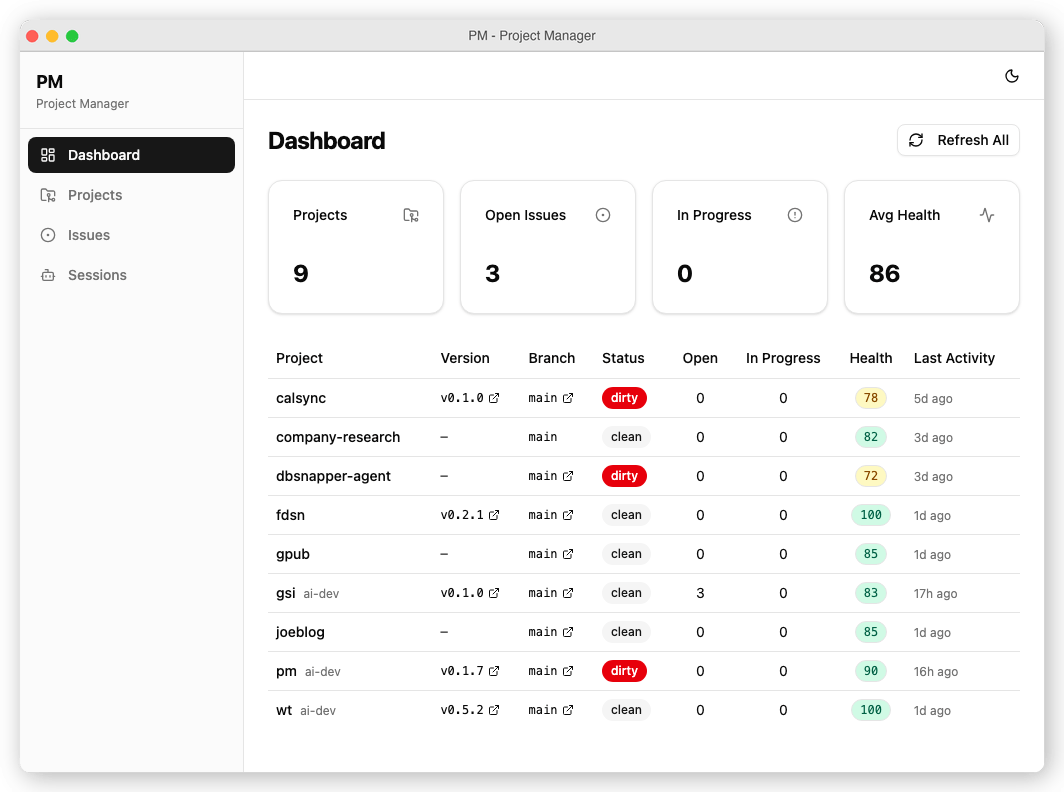 A Project Manager application to keep track of all my projects - One of many applications I've developed and released last week.
Before
About a year ago, I was rather skeptical of AI development. My attempts to use it were mostly constrained to code autocomplete, with occasional uses to generate larger code snippets often met with frustration.
I was reserved in my expectations. I saw a looming battle for AI to overcome model collapse, and a capabilities ceiling where models would struggle to improve beyond a certain point without some major breakthrough.
Now
With the release of Opus 4.6, I have realized that I can rather reliably generate code that matches my intent and often on the first try. One of the first apps I created was wt, a command-line tool to manage git worktrees to enable parallel feature development. This app increased the speed at which I was able to develop features and fix bugs with AI, and before I knew it, I had to upgrade to the Anthropic Max 20x plan to keep up with the demand of my AI usage.
During that week, I read many articles about other individuals and teams experiencing similar things:
- Teams generating code - 100% vibe coded, in hours or days, no IDE, minimal to no code inspection.
- AI fatigue and burnout - the mental exhaustion caused by keeping track of multiple projects and multiple parallel development branches per project.
- Something is Happening posts, where individuals are sounding the "alarm" that they too are witnessing the same thing, and that the much anticipated socioeconomic impacts of AI are here, and about to accelerate.
- People creating new frameworks and tools to manage context, projects, parallel agents. Many are building their own tools to manage the current limitations of their favorite AI model. I think this is normal, and will continue, but most will just be personal tools. Some that try to commercialize will find that rather than adopt someone else's tool or framework, people will just build their own with AI.
I still see many technical and non-technical people that are either skeptical of the capabilities of AI, or just not paying attention. Some are software "artists" reluctant to see their craft automated. Others are fearful of the implications on their jobs and industries. I get it. There are real concerns here, from environmental costs to ethics to job displacement.
But the capabilities explosion is happening regardless, and understanding it clearly matters more than ever. Most people just haven't spent the time to explore and experiment properly. It takes more than a few casual prompts or coding attempts with a free watered-down model to understand what's happening right now, and it's easy to get a bad impression of AI if you don't have a good adoption plan to follow.
AI Development in Startups
Many business leaders have been hyping AI in their companies for a while now (and layoffs as a result), but the actual rollout and implementation of AI tools has been hesitant and slow. I have worked with several companies to fast track their AI development tools usage from policy to progress, helping them understand the capabilities and limitations of AI, and how to best adopt it for their teams.
Staying current on AI developments matters too. The tools change fast, and falling behind means your team isn't working with the best options available.
The Future
February 2026 has been a major inflection point. AIs are now writing themselves. The next major release of Opus (likely 3-6 months away) should be even more mind-blowing than 4.6, assuming the current LLM architecture holds. Likely this will be the point where most who haven't adopted AI for development will begin to do so. Meanwhile the competition has had a 6-12 month head start and is likely to continue to widen the gap in capabilities. AI is not going away, and the capabilities explosion is just beginning. The next 12 months will see significant changes in how software is developed, who is doing it (or not), and the types of software products that will have a sustainable market.
If your company or development team is not yet using, or struggling with effective AI adoption, get in touch with me to help you get up to speed and take advantage of the capabilities explosion.